Showing posts with label Communism In Ambush. Show all posts

Saturday, September 8, 2012

The Important Reality that Invalidates Materialism


LENIN COMMANDED HIS COMRADES, 
"DO NOT THINK, OR ELSE YOU WILL BELIEVE."

The world to which we're connected is composed not of matter, but perceptions. Because this fact knocked the foundations from under materialist philosophy, its ideologues are very uncomfortable and try not to think about it, even recommending that their colleagues not think about it either. Chief among them is Lenin. In Materialism and Empirio-Criticism, a book he wrote a century ago, he warned that materialists should not think about this subject, else they might become "caught up" in religion:
Once you deny the objective reality [that is] given us in sensation, you have already lost every weapon against fideism [reliance on faith alone], for you have slipped into agnosticism or subjectivism-and that is all that fideism requires. A single claw ensnared, and the bird is lost. And our Machists [an adherent of Machism, developed by the Austrian philosopher Mach, one of the leaders of modern positivism], have all become ensnared in idealism, that is, in a diluted, subtle fideism; they became ensnared from the moment they took "sensation" not as an image of the external world, but as a special "element." It is nobody's sensation, nobody's mind, nobody's spirit, nobody's will.1
As this quote shows, the only thing materialists can do about the "real nature of matter" is to avoid thinking about it!-the clearest indication that the myth of materialism derives its strength only from people's self-deception.
1- (V. I. Lenin, Materialism and Empirio-criticism, Progress Publishers, Moscow, 1970, pp. 334-335)


WARNING
The chapter you are about to read reveals a crucial life secret. It should be read attentively and thorougly, for it is concerned with a subject that is liable to make a fundamental change in one's oulook toward the external world. The subject of this chapter is not merely a point of view, a different approach, or a traditional philosophy. It is a fact which everyone, believers and non-believers, must admit to and which has been proven by science today.
The Important Reality that Invalidates Materialism
At the root of the Communists' nightmare of anguish throughout the 20th century lies the Darwinists' materialist creed. Blindly accepting materialist philosophy, Communists regard everything as composed of matter only, rejecting the idea that human beings have spirits. In the same way, their adoption of Darwin's theory of evolution led them to qualify human beings as no more than "advanced animals."
This and the following chapter will explain why this ideology is unsound. First off, we'll consider a very important reality that invalidates the very foundation of the materialist dogma that regards everything as being composed of matter. The second chapter demonstrates Darwinism's invalidity from a scientific standpoint, showing that human beings have always existed on this Earth as humans-distinct from animals-and have a spirit and consciousness God has given them.
First of all, let's take a short look at the system of thought that holds matter as absolute, denying the existence of anything else. As a result of this flawed logic, materialists reject obvious existence of God (surely God is beyond that) and cannot conceive that all things continue to exist by God's will. Materialists' warped philosophy stems from this flawed conception, and is described in the Qur'an (23:37) as the materialists themselves might express it:"What is there but our life in this world? We die and we live and we will not be raised again." Another verse (30:7) describes the great error of these people who deny God and the afterlife: "They know an outward aspect of the life of this world but are heedless of the hereafter."
Why did materialism fall into this error, which gave rise to such flawed conceptions? One reason is that never in their lives have they realized a very important reality. And not being aware of it, they believe that their entire lives are limited by the material world. Therefore, their entire relation to the world is dominated by ambition. In the following pages, we will reveal this important reality, of which godless people are unaware.
The Real Face of Matter
We are about to demonstrate a reality that invalidates the roots of materialist thought: not a philosophy or ideology; but a technical reality that everyone inhabits whether he knows it or not, which has been proved by various branches of science. If approached with care and sincerity, without prejudice, it is very easy to understand. This reality can be summarized like this: "All material existence that form us and our environment is a totality of conception. The concept of what we call "matter" is like a dream, conceivable only as an image in our minds. We can never have any connection with its original that exists outside us."
The "reality behind matter" is not formerly unknown and only newly discovered. Throughout history, God has sent apostles and other deeply aware, thoughtful people to proclaim this reality, which is alluded to in a number of verses of the Qur'an and plays a key role in interpreting still other verses. Texts containing portions of these individuals' proclamations have come down to us today; while various degenerated forms of the true religion-whose original revelations have been distorted-have sought to preserve this reality as a mystical secret.
One can find this reality in surviving texts of Zoroastrianism, Buddhism, Taoism, Judaism and Christianity. Ancient Greek philosophers such as Pythagoras and Plato (especially in his Allegory of the Cave), the Eleatic school of philosophy, and a number of the thinkers who followed them all expounded one aspect of this question. In later periods, it has been related and taught by people who, under the influence of differing viewpoints and various interpretations, have thought about it deeply and arrived at the truth.
Those who claim that matter is the one absolute principle of existence, tried to cover up this reality. But George Berkeley, the Irish theologian and philosopher, raised this question again in the 18th century and in so doing, changed the world of ideas after him.
Because materialists-especially Bertrand Russell, the most passionate spokesman of this school-could not refute Berkeley philosophically, they attempted to insult and slander him. Even though Russell was the most representative thinker in materialist circles and the strongest defender of this view, he couldn't disregard this truth. In The Problems of Philosophy, he admitted that: "Berkeley retains the merit of having shown that the existence of matter is capable of being denied without absurdity, and that if there are any things that exist independently of us, they cannot be the immediate objects of our sensations."124
However much Russell might claim the opposite, in his statement above, he basically could not deny this reality, but even openly states that he accepts it.
Actually not only Russell's outlook, but the entire materialist philosophy is about to collapse. As we step into the 21st century, modern developments in physics, quantum physics, astronomy, psychology and anatomy and other branches of science are deeply discomfiting those who espoused the old materialist view of the world. The study of fossils and research conducted in areas like genetics have caused the theory of evolution to collapse. Research in optics and psychology have helped solve the mystery of our cognitive system; as a result of advances in astronomy, the Big Bang theory-proposing that the universe and matter had a beginning-has become generally accepted. Research into atoms and sub-atomic particles has turned classical physics inside out, proving the theory of relativity- that time itself is relative.
Countless scientific discoveries have confirmed the existence of God and His eternal sovereignty over the whole universe, leaving with no recourse those materialist thinkers who represent fanaticism and prejudice. Their powerlessness also continues today. On television, in schools, and at lectures, we encounter scientists and thinkers who feign ignorance of the fact that we can't get in touch with the external world, that our experience is composed of perceptions felt in our brain; and proceed not to inform people of the truth, even behaving as if it did not exist. But ignoring the truth is no solution. Let us examine this reality a little more closely.
What We Perceive As Outside Is Actually Inside Ourselves
Stimuli such as light, sound, smells, tastes and textures from objects assumed to exist in the external world are carried through nerves to sensory centers in the brain. All these stimuli consist of electric signals. During the process of sight, for example, light rays (photons) radiating from the exterior world reach the retina at the back of the eye, which transforms them through a series of processes into electric signals. These signals are transferred along nerves to the center of vision at the rear of the brain. Thus, the colorful, bright, three-dimensional world is perceived within this center of only a few cubic centimeters.
The same process also enables the other senses. Tastes are transformed into electric signals by cells on the tongue's surface. Smells are transformed into electric signals by cells in the epithelium of the nose. Special sensors lodged under the skin transform impulses of touch (such as feelings of firmness or softness) into electric signals, and a special mechanism in the ear transforms sounds in a similar way. All these signals are sent to respective centers in the brain, where they are finally perceived.
To clarify the point, assume you are holding a cup of coffee. Receptors under your skin transform the cup's hardness and heat into electric signals and send them to your brain. Simultaneously, the coffee's strong smell, its taste and dark brown color all become signals sent to the brain. The clink when the cup touches the table is perceived by your ears and sent to the brain as an electric signal. All these perceptions are interpreted in the relevant brain centers, working harmoniously with one another. As a cumulative result of these impulses, you sense yourself drinking a cup of coffee.
Anyone who sits in a room, watching television or dining with his family, experiences a great miracle, even though he is unaware of it. The image of four surrounding walls is, in reality, within that person's brain.
That being the case, are you in the room, or is the room inside you?
Most people are unaware of this great truth, assuming themselves to be sitting in a room, watching television or chatting with their family. Those who do grasp this fact, on the other hand, pretend not to understand this miracle, since they fear it. Yet this fact of which they plead ignorance is undeniable, confirmed by science. Stimuli reaching the eye from the room's four walls, the pictures or paintings on them, the television, carpet, furniture, and light on the ceiling are all transformed by the retina's cells into electrical currents, then transmitted to the visual center in the brain. A person perceives the image of the house, which he thinks he is in, in a tiny space in the rear of his brain.
Never in his whole life can he move outside this space; never can he see another image, apart from the one on the "screen" in his head. He can never hear a sound apart from those transmitted to his brain. A person lives out his whole life within this small, bony room.
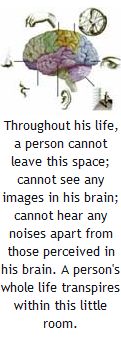


Everything we see around us is the work of electrical signals producing an image in our brain. To explain this more clearly, imagine that you are looking at the bowl of fruit on a dinner table. When light rays from it reach your eyes, several operations come into play: The rays, converted into electrical stimuli, are transmitted by nerves to your brain's visual center. In this way we can say that we see "fruits of various colors," as can easily be found in any biology or physiology textbook. But what is most amazing is that the visual center is a place of complete darkness. Actually there is no screen in the brain: When electrical stimuli come from the table, no image is formed in the visual center. When we say we see the table and the fruit on it, we are actually seeing electric signals transmitted in total darkness.
Here we meet a fact.


What we call the visual center is composed of fat, protein and nerves. It cannot perceive incoming electrical signals as images by these. In that case, who is it that sees the electric signals in the darkness of the brain without the need for eyes?
This is what materialism, with its lying attempts to explain everything in terms of basic matter, can never understand. What leads materialists definitely into a blind alley is an extraordinary reality thatmost people cannot conceive of. In the darkness of our brain is a being that need no eyes to see a table clearer than one projected on the finest television-three-dimensional, life-like and indistinguishable from the original.
What sees this perfect image is also what separates human beings from animals and all other animate and inanimate things is the Spirit that God "breathed into" them when He created them. In the Qur'an (15: 28-30), God reveals the existence of the "spirit" in these words:
When your Lord said to the angels, "I am creating a human being out of dried clay formed from fetid black mud. When I have formed him and breathed My Spirit into him, fall down in prostration in front of him!" Then the angels prostrated all together, every one of them.
Copies Indistinguishable from the Originals
Miraculously, the perceptions of the spirit are completely the same as reality. Despite the fact that the spirit has nothing to do with material originals, but only with electrical signals reaching the brain, it sees shapes and colors and feels hardness and texture, just as they are in reality. So clear are these impressions that he's convinced that he's seeing and touching the original.
For example, a swimmer in the sea's cool, blue waters is actually immersed in a great miracle. He thinks he is swimming in the water, but has never emerged from the darkness inside his brain. From the moment he entered the water, every stimulus entering his body is immediately converted by the cells into electrical current and transmitted to his brain. At this point, something miraculous happens: the spirit, with no arms or legs to stroke with or feel the wetness, senses that water is touching his skin and buoying him up.
However, the person never has any connection with the color of the water, its temperature, and the sound of the waves-all these things are inside the human brain. A person really has no connection with the original of even his own body that exists in the external world; but only perceives electrical signals from inside it. Even though this miraculous reality is taught in schools and written about in textbooks, many people are not aware of this extraordinary reality; and most of those who are aware of it do not want to understand it.
The Reality that Materialists are Afraid to Understand
In light of this extraordinary and exciting knowledge, consider that all the material things you know in this world-your house and belongings, spouse and children, your parents and colleagues-are perceived as images that occur in the darkness of your brain. Has it ever occurred to you that you are fixed to an image that occurs in your brain, you can never see the outside, you can see the things listed above only in your brain and you can never get outside this small world?
If the materialists-who deny the existence of the spirit, believing that matter is the only reality-accepted this obvious truth, they would have to throw aside all the principles and goals on which they've based their lives. Angered by this great miracle, they have resorted to many methods to attack it and made irrational claims to obfuscate the facts. Some materialists pound tables with their fists or kick walls to convince themselves that matter is not a perception. Other materialists may claim that a bus hitting someone is no mere perception, but objectively "real." They want to escape the understanding that all feelings of pain from the impact are already perceptions formed in the brain; the victim has never been in contact with the "actual" bus. Again, all the sensations of the blow are perceived in the darkness of the brain, by the human spirit.
The Huge Trap into Which Materialists Have Fallen
Materialist philosophy has always existed throughout history. Very assured of themselves, materialists revolted against God Who created them and maintained that since matter had no beginning nor end, it couldn't possibly have been created. Denying God out of their arrogance, they took refuge in matter which they held to have the only "real" existence. So confident were they in their arrogance and denial that they believed that no argument put forth could ever disprove it. That's why the facts regarding the real nature of matter surprised them so much. Suddenly it destroyed the very basis of their philosophy-matter, on which they based all their lives-and left no ground for further debate. They saw the material world, in which they so blindly believed in, trusted and relied, taken away and could do nothing about it. Since no human being actually sees the reality of matterthat exists outside us, hears real sounds, or smells genuine scents, how can we talk of materialism?
One of the attributes of God is His plotting against the unbelievers, as stated in the Qur'an, verse (8: 30):
They plot and plan, and God too plans; but the best of planners is God.
God entrapped materialists by letting them assume that matter exists and in so doing, humiliated them in an unseen way. Materialists grew arrogant against God by relying on their possessions, status, rank in society. They revolted against God by being boastful (surely God is beyond that) and adding to their unbelief by relying totally on matter. Yet, they were so lacking in understanding that they failed to realize that God encompasses them. In the Qur'an (52: 42), God reveals the state to which unbelievers' thick-headedness leads them: "Or do they intend a plot [against you]? But those who defy God are themselves involved in a Plot!"
This is most probably the biggest defeat in history. While growing arrogant of their own accord, materialists have been tricked and suffered a serious defeat in the war they waged against God by devising a monstrous thing against Him.
In another verse (24: 39), God says: "But the disbelievers, their deeds are like a mirage in sandy deserts, which the man parched with thirst mistakes for water; until when he comes up to it, he finds it to be nothing." Materialism, too, becomes a "mirage" for the rebellious when they seek to depend on it. Just as stated in this verse; they find it to be an illusion. God has deceived them with such a mirage, beguiling them into perceiving this whole collection of images as real.
All those eminent professors, astronomers, biologists, physicists and others, regardless of their rank and post, are simply deceived and humiliated for having taken matter as their god. Assuming a collection of images to be absolute, they based their philosophy and ideology on them,and involved themselves in serious discussions. They deemed themselves to be wise enough to offer an argument about the truth of the universe and, more importantly, adopted a so-called "intellectual" dispute about God, Who explains their limited intelligence in the Qur'an (3: 54): "And [the disbelievers] plotted and planned, and God too planned, and the best of planners is God."
From some plots, it may be possible to escape. But there is no way to avoid God's plan against the disbelievers. They can never find a helper other than God. As God states in the Qur'an (4: 173), "They shall not find for them other than God a patron or a help."
For materialists, realizing this fact is no doubt the worst possible thing, because it leaves them all alone with God. Thus, they understand that God is always with them and He encompasses all things. With verse 74: 11 of the Qur'an, God calls us to remember that each human is, in truth, totally alone in His Presence: "Leave Me alone, [to deal] with the [creature] whom I created alone!"
This remarkable fact is repeated in many other verses:
And behold! You come to us alone [individually] as We created you for the first time: you have left behind you all [the favors] which We bestowed on you. (Qur'an, 6: 94)
And each one of them will come unto Him on the Day of Resurrection, alone. (Qur'an, 19: 95)
In another sense, these verses state that those who take matter as their god have, nonetheless, come from God and will return to Him. They have submitted their wills to God, whether or not they wanted to. Now-however unwilling they may be to realize it- they await the Day of Judgment, when every one of them will be called to account.
The Importance of the Subject
It is of the utmost importance to understand correctly the secret beyond matter explained in this chapter. Mountains, plains, flowers, people, seas—briefly everything we see and everything that God informs us in the Qur’an that exists and that He created out of nothing is created and does indeed exist.However, people cannot see, feel or hear the real nature of these beings through their sense organs. What they see and feel are only their copies that appear in their brains. This is a scientific fact taught at all schools of medicine. The same applies to the book you are reading now; you can not see nor touch the real nature of it. The light coming from the original book is converted by some cells in your eyes into electrical signals, which are then conveyed to the visual center in the back of your brain. This is where the view of this book is created. In other words, you are not reading a book which is before your eyes through your eyes; in fact, this book is created in the visual center in the back of your brain. The book you are reading right now is a “copy of the book” within your brain. The original book is seen by God.
It should be remembered, however, that the fact that the matter is an illusion formed in our brains does not “reject” the matter, but provides us information about the real nature of the matter: that no person can have connection with its original. Moreover, the matter outside is seen not just by us, but by other beings too. The angels God delegated to be watchers witness this world as well:
And the two recording angels are recording, sitting on the right and on the left. He does not utter a single word, without a watcher by him, pen in hand! (Surah Qaf: 17-18)
Most importantly, God sees everything. He created this world with all its details and sees it in all its states. As He informs us in the Qur'an:
… Heed God and know that God sees what you do. (Surat al-Baqara: 233)
Say: "God is a sufficient witness between me and you. He is certainly aware of and sees His servants." (Surat al-Isra’: 96)
It must not be forgotten that God keeps the records of everything in the book called Lawh Mahfuz (Preserved Tablet). Even if we don't see all things, they are in the Lawh Mahfuz. God reveals that He keeps everything's record in the "Mother of the Book" called Lawh Mahfuz with the following verses:
It is in the Source Book with Us, high-exalted, full of wisdom. (Surat az-Zukhruf: 4)
… We possess an all-preserving Book. (Surah Qaf: 4)
Certainly there is no hidden thing in either heaven or Earth which is not in a Clear Book. (Surat an-Naml: 75)
They said "Glory be to You! We have no knowledge except what
You have taught us. You are the All-Knowing, the All-Wise."
(Qur'an, 2: 32)


124. Faruk Sukru Yersel, Eskisehir Gazetesi (Eskisehir Newspaper), 1926


COMMUNISM LURKS IN HIDING


Mention the theory of evolution in the United States, and the first name that usually springs to mind is that of the late Stephen Jay Gould. For years he was professor of Zoology and Paleontology at Harvard University, wrote many books supporting evolution, and made many media appearances to speak about this topic. When there is an argument about evolution, world-famous magazines like Time and Newsweek quote Gould's view. His books appear prominently in bookstores and in the giftshops of natural history museums.
Gould tried to cover up Darwinism's shortcomings and make up for its refutation in the face of the fossil record. Of course, he was not successful. That's why Professor Phillip Johnson of Berkeley, a well-known critic of the theory of evolution, calls Gould the "Gorbachev of Darwinism."114 Gould himself even confessed his lack of success on many occasions. (For more detailed information, refer to Darwinism Refuted:How the Theory of Evolution Breaks Down in the Light of Modern Science, by Harun Yahya, Goodword Books, 2002)
Stephen Jay Gould was as attached to Marxism as he was to Darwinism, and admitted this openly. For him, Marxism and Darwinism were two sides of one coin. Darwin explains the "dialectics of nature" and Marx explains the "dialectics of history." Gould's attachment of Darwinism was actually the result of his commitment to dialectical materialism. He rigorously defended Darwin because "Darwin applied a consistent philosophy of materialism to his interpretation of nature."115
In 1992, this famous Marxist-Darwinist went on a trip to Russia. A few years before this trip, the Eastern Block had split up; one year earlier, the Soviet Union had collapsed and the Communist Party no longer existed. The whole world was convinced that Communism had fallen. But Gould interpreted the event otherwise. On his return, he stated to reporters that, "Yes, the Russian reality does discredit a specific Marxist economics,"-but went on to say that Marx has been proven right about "the validity of the larger model of punctuational change."116
According to Gould, Marxism is still alive.
Communism is Alive as Well
Stephen Jay Gould's commitment to Darwinism is not an exceptional case. Among the well-known 20th century scientists who accept the theory of evolution, many have been Marxists. In the first half of the last century, individuals like Alexander Oparin and J.B.S. Haldane were all passionate Marxists who carried out their most important experiments in the name of evolution. Western evolutionist scientists like John Maynard Smith and Richard Lewontin are still avid defenders of Marxism.
According to these men, Darwinism and Marxism have the same meaning. Each theory is based on a common philosophical foundation: Dialectical materialism, which Marx applied to history, and Darwin applied to nature. According to these people, the universally held idea that Communism collapsed along with the fall of the Soviet Union and the Eastern Bloc is wrong, only "a false interpretation of Marxism" has fallen. As long as dialectical materialism lasts, a Marxist understanding of politics will endure.
This idea is accepted by many individuals and organizations that still believe in Marxism. While the Soviet Union and the Eastern Bloc still existed, these contemporary Communists separated Communist regimes from Marxist ideology. They called existing Communist regimes "real" or "living" Socialism, contending that socialist ideology is not integral to these regimes; even if they collapsed, it would remain.
Their claim-still considered valid today-is that according to Marx, a society must undergo particular evolutions, advancing first from capitalism, then to socialism and finally to Communism. Russia and other 20th century Communist regimes, however, experienced a sudden passage from an agricultural society to socialism, omitting the intervening capitalist stage. Therefore, according to Marxists, it's only natural that these regimes did not succeed. Today, these countries have adopted capitalism, to develop through the "stage of capitalism" that Marx spoke of. When socialism finally comes, it will be stronger and more enduring.
Many who still believe in Marxism have adopted this interpretation. Their number includes leading scientists like Stephen Jay Gould to European Communist parties, from Marxist intellectuals and journalists to separatist Communist terror organizations. Therefore, it's very wrong to think that Communism has passed into history with the collapse of the USSR and the Eastern Bloc, and poses no more threat to the world. Communism is a political expression of dialectical materialism, so that if that theory survives, so will Communism. If a particular philosophy is strong in a society, it is only a matter of its finding an appropriate environment to make itself politically influential. If the philosophy of dialectical materialism becomes strong and widespread, then Communism-its political aspect-may become an influential force.
In today's world, there is generally a strong trust in democracy and a liberal economy. But any international crisis in the liberal economic order could change people's tendencies and psychology. This has happened before. Following the Crash of 1929, a serious economic crisis throughout the whole world quickly increased the popularity of Communism and Fascism in Europe. Communists interpreted the Great Depression as the "collapse" of the capitalist system and used it as an opportunity to influence the masses more easily.
At present, Communists have considerable power, especially in Europe. Communist parties in France and Italy remain strong and in elections, they obtain a high proportion of votes. Almost all the former Eastern Bloc countries have socialist parties led by former Communist party members, who also obtain a substantial number of votes. A new international crisis could push these countries to strengthen their socialist parties and from there, into Communist regimes.
Russia: One Forward, Two Back!
A very narrow line separates Communism and Fascism, which are like two opposite sides of the political fan. Each ideology has a similar social and moral structure and the same model of leadership. Social science includes each in the same class of "totalitarian ideologies." Totalitarianism is a model in which the state controls society with propaganda, oppression and fear, and where opponents are removed by the most merciless methods.
After 1991, Russia's political regime and political culture did not change very much. They just passed from Communism to a kind of Fascism based on the domination of the mafia. Basic changes occurred only in the economy and social structure. Many people became rich very quickly, but most people's living standard fell. A growing chasm formed between the rich and the poor, and Russia acquired a "brutal capitalist" structure similar to that of 19th-century England. With weak state authority and the appearance of organized crime, a kind of "feudal" structure came into being.
Interestingly, these two newly formed structures-"brutal capitalism" and "feudalism"-fulfil the conditions required for the Revolution according to Marxism. From a Marxist perspective, Russia's present structure is "pre-Communist." The Communists who have the majority of the votes and influence state mechanisms, think that in the event of an international crisis that shakes confidence in democracy and a liberal economy, Communists could turn this theory to practice. Russia could once again easily pass into the hands of a Communist regime.
Here, we notice one of Communism's sly tactics: creating an order that arises out of the breakdown of their own chronology of history (the passage from capitalism to Communism). For this reason, they surrendered the Russian people into the hands of the mafia and prepared the environment for the coming of classical capitalism. They crush the people with the very system they've established, trying to make them believe that there is no other solution but Communism.
On the other hand, Communism continues to exist in secret. Russia's present authorities are all former Communists, educated according to Marx's dialectical materialism and have not given up their dreams of a Communist state. On the contrary, they believe that Communism must develop from the capitalist phase and look on while capitalism is exercised because they regard this as a requirement of being a "Communist." They currently support and implement capitalism at this particular time because they are truly Communists.
Those who have adopted the principles of dialectical materialism find it easy to appear to be Communists one day and Fascists the next, in order to eventually achieve their goal. Because the goals of Fascism and Communism are the same-to oppress people-the line between these two ideologies is very indistinct. The only difference is that Communism continues its oppression secretly, under "humanistic" slogans while trying to validate its characteristic oppression and brutality.
Behind these various curtains of secrecy, Communism is still in power in the Russian State, which has a classical Communist structure. The USSR's military control over the Turkic republics still stands. Even in their capitalist system, passionate Communist members continue to oppress the people. Their anti-religious and amoral suggestions alienate society from its moral values and encourage it to dismiss the existence of God. After this, no reason remains for them not to accept Communism.
Russian Communists, who still march carrying posters of Stalin and Lenin, have power that cannot be despised or underestimated. In his 1904 book, One Step Forward, Two Steps Back, Lenin stated that on the road to any eventual goal, there must be a temporary step backward. This is how the Communists regard the collapse of the USSR in 1991. In this book, Lenin wrote:
One step forward, two steps back. . . . It happens in the lives of individuals, and it happens in the history of nations and in the development of parties. It would be the most criminal cowardice to doubt even for a moment the inevitable and complete triumph of the principles of revolutionary Social-Democracy, of proletarian organisation and Party discipline.117
THE STEALTHY TACTIC OF DIALECTICAL MATERIALISM: 
ONE STEP FORWARD TWO STEPS BACK

Those who think that Communism collapsed a few years ago and is no longer a danger today are very mistaken. In accordance with its doctrine of Dialectical Materialism, Communism has only taken a tactical retreat. According to Lenin's book, One Step Forward; Two Steps Back, sometimes Communists must take a few steps backwards and appear to be retreating from their goals in order to achieve them. Chinese school children are taught the "dialectical way of walking"- two steps back, three steps forward.
One concrete example of this is Communist thinking about the family. According to Karl Marx, founder of Dialectical Materialism, the institution of the family must be abolished in order to achieve Communism. In the Communist Manifesto, Marx and Engels wrote, "Abolition of the family! Even the most radical flare up at this infamous proposal of the communists."a and then proceeded to explain their own reasons why the family must be abolished. They proposed that the "bourgeois family" is dependent on capital and private gain, and that when these were removed (that is, after the Communist revolution), the family would disappear too. The family, they claimed, would vanish as a matter of course when its complement vanishes.
In his book Origin of the Family, Private Property and the State, Friedrich Engels tried to show that in the first period of human history, the family did not exist but appeared only later, as an artificial institution for purposes of exploitation. According to this philosophy of Engels, when the Communist revolution came, the family, along with the state and private property, would disappear.
To achieve these goals, Communists follow the doctrine of Dialectical Materialism. In order to abolish the family, they need a powerful state. But for a state to be strong, first the family institution must be strong. By first taking one step backward, they strengthen the family and the Communist state grows strong. Then one stage later, it abolishes the family.b Communists are deceiving the people by proclaiming that Communism has collapsed and that family ties have become stronger in Russia. This tactic of Dialectical Materialism is stressed by Lenin in One Step Forward, Two Steps Back. Communism has changed its color like a chameleon and is waiting, while it prepares a suitable foundation.
For this reason, there must be a serious struggle in the realm of ideas with Dialectical Materialism, Communism's founding philosophy, and with Darwinism-its supposed "scientific" basis. Otherwise, Communism, now waiting in ambush, will take its brutal and bloody steps forward.
a- Karl Marx and Frederick Engels, Manifesto of the Communist Party, Moscow: Foreign Languages Publishing House, 1957, pp. 79-80. 
b- Dr.Fred C. Schwartz, You Can Trust the Communists to be Communists, Prentice Hall, 1960.

Mao Lives!
In Eastern Europe and Russia, Communist systems that collapsed in the 1990's are likely to come back to life. But another kind of Communism never has collapsed and, under the appearance of capitalism, continues to gain strength every day. This version of Communism is the worst and most barbarous kind: Maoism.
After Soviet Russia collapsed in 1991, statues of Lenin and Stalin were toppled from their places. Russia abandoned Communism-supposedly. But in China, such has never happened. From Mao's death in 1976 to the present, the Communist Party still governs. China adopted the rules of a capitalist economy and has made great economic advances as a result, but its political system is still Communist. And strangely, Mao, the murderer of tens of millions of Chinese, is still regarded by the Chinese as a holy figure.
On January 10, 1994, Time magazine published an article, "Mao Lives!" reporting a mass pro-Mao movement in China that it termed "Mao-mania":
Mao to ordinary Chinese is still a sphinx, an idol with a hundred faces whose words, like Scripture, are quoted to almost any purpose. . . . A wave of retrochic has washed over the country as collectors grab up recordings of Mao's preachments, as well as badges, books, cigarette lighters and even yo-yos bearing his image. Not all the souvenirs are gimcrackery: some 5,000 gold-and-diamond watches commemorating his Dec.26 birthday have been selling at the lucky-eight but eye-popping figure of 8,888 yuan: $ 1,530, or 30 times the average monthly wage. . . . In the south-central province of Hunan, the Great Helmsman's birthplace of Shaoshan draws swelling numbers of pilgrims: more than 1 million in 1992 alone. The town recently unveiled a 10-m-high bronze statue of its favorite son.118
In 1997, the American magazine New Republic published an important article entitled "Mao More Than Ever," describing the "idolization" of Mao in China:
Mao Zedong remains the central, dominant figure in Chinese political culture: he is still an imperial presence; he is still revered; he is, even, still cool. The evidence is everywhere in China. In a 1994 poll, 40 percent of Chinese respondents picked Mao as their favorite leader, compared to less than 10 percent for Deng Xiaoping. "Today Chinese youths don't know or take seriously Mao's mistakes," Yan Jiaqi, a former member of the Chinese Academy of Social Sciences, told Asiaweek. "They think he was a great leader. They only know Deng's mistakes." In the countryside, new and massive temples have been built to Mao in the Fujian and Guangdong provinces, and another temple is under construction in the northern Shaanxi province of Gushuicun. The temples are frequented by party officials and peasants who believe Mao can do everything from cure illnesses to guarantee a good crop. In 1993, several workers at a Sichuan factory committed suicide on the one-hundredth anniversary of Mao's birth--they were convinced they would join him in an afterlife. Taxicab drivers in Beijing and Shanghai dangle Mao's portrait from their rearview mirrors. Artists are incorporating Mao's image into their works, and a gigantic portrait of Mao still looms over Tiananmen Square. And, most importantly, in the party and in the universities, the fashionable political philosophy isn't democracy; it's the new Maoism.
Mao hasn't made a comeback. He never left. Unlike Germany or Russia, China has never made an attempt to confront its past; it never tried to engage in de-Maoification. The Communist Party has resisted any attempts to confront either the horrors of the late 1950s Great Leap Forward, when a Mao-made famine took tens of millions of Chinese lives, or those of the Cultural Revolution, in which state-sanctioned barbarity reached the nadir of encouraging cannibalism among school children. Efforts to speak the truth about these matters are squelched: when, for example, the Shanghai University journal Society stated in 1993 that 40 million had perished in Mao's famine, that issue of the magazine was instantly recalled.
What informs China's politics is what has informed it for the last fifty years: a philosophy that mixes nationalism and communism and that is built upon the legend of Mao as founding father.119
So, what does this post-Mao capitalism mean? Is it a departure from Maoism in China, or the strengthening of the economic aspect of Maoism? The same article states:
Even after the denouement of the Cultural Revolution-the humiliation of Mao's wife and the other members of the Gang of Four-the cult of Mao lived. Although veneration had, for the time being, receded among the Chinese people, the party continued to occupy itself intellectually with Maoism. Two main groups emerged, Maoist fundamentalists (fanshipai) and nostalgists (huanyuanpai) who yearned for the golden age of the 1950s. The party Maoists kept the faith alive, but, with the barbarity of the Cultural Revolution still fresh in familial memories, they could not much fan it openly. For the nationalist-communist philosophy of Maoism to blossom fully again, there needed to appear a threat to China, an event that would awaken among the people the resting fear that China might lose its greatness, might fall prey to the depredations of the West. This event occurred on June 4, 1989, when Chinese troops mowed down student protesters at Tiananmen Square. In the wake of Tiananmen, the idea of China descending into chaos and collapse prompted the party to revive the idea of class struggle. . . . China, Jiang [Zemin] said, would continue to pursue economic reforms, but no one should be deluded that democratization would take place. Under Jiang's supervision, the party has promoted "thought reform" in the countryside and carried out Maoist-style education campaigns.
Much of the firepower for these attempts to restore Maoism has come from a group of young intellectuals clustered around party elder Deng Liqun. These Marxist fundamentalists control the People's Daily, the ministry of propaganda and numerous journals such as Seeking Truth. . . . In 1995 and 1996, they issued two "ten-thousand-word documents" calling for a return to class struggle and Maoism."120
Obviously, Maoism still dominates China. It's not simply an inheritance of aged Communist Party administrators from Mao's time, but a living inheritance for a younger generation still blindly bound to Marxism. Peasants and the uneducated masses view Mao as a supreme being; most intellectuals consciously espouse and disseminate Marxist-Leninist-Maoist ideology. Chinese capitalism is simply hiding and strengthening Maoism.
China is the world's most populous country, and its economy continues to grow. Its arms production is such that, in the 21st century, it is thought that China will rival the United States as a superpower. That an ever- stronger China is still Maoist, with "Mao-mania" thriving among its 1.2 billion population, shows once again that Communism is not dead but is only hidden. Worse still, this is Maoist Communism, the most barbarous and brutal version.
The Universal Maoist Movement
Mao is alive not only in China, but internationally. After the Soviet Union's collapse, international Communism's center of gravity shifted to Maoism. Communist establishments in place in both North Korea and Vietnam, still rule according to Maoist ideology. Most noticeably, terror organizations in various parts of the world have adopted Maoism and commit acts of bloodshed in Mao-style guerilla wars. Maoist organizations from different countries have joined together in what is called the "Maoist Internationalist Movement," while European Communist parties have gained great support.
On the official Internet site of the Northern Cyprus Turkish Republic, the following analysis appears about the International Maoist Movement:
According to statistics from the International Terror Research Center, in recent years there has been a notable increase in the number of Marxist-Leninist-Maoist terrorist organizations. Sources monitoring international terrorism report that Maoism is engaged in intense activity, in both words and actions.Foremost in their universal objectives and ruthless anti-Western, anti-democratic mindsets are the Maoist "Tamil Tigers" in Sri Lanka, the "Shining Path" in Peru, the Khmer Rouge in Cambodia and others whose names are only beginning to be heard.
The Maoists' aim is to spread Mao Tse-tung's teachings by means of bloodshed and replace democratic regimes with a Marxist-Leninist-Maoist state, by means of armed struggle. Their underlying objective, of course, is to spread Maoism throughout the entire world.
Maoist terrorist organizations from East and West met twice, in America and India, during 1996, and vowed to pursue a policy of joint action. Folowing the meeting in America, they decided: :
To overthrow parliamentary democracy in countries where they are active.
In order to achieve their aims, to kill not only soldiers, police officers, and members of the state apparatus, but anyone who is not one of them-making no exceptions of children, women, or the elderly.
To construct a centralist, single-party administration in which human rights are disregarded.
To build a world revolution based on Marxist-Leninist-Maoist ideology.
Another important decision taken at these meetings was to build a "Maoist propaganda center" in order to lay the foundations of the "world revolution."This center, known as the Maoist International Movement (MIM), is believed to be active in Canada. Within the framework drawn up by "Internationalist Maoists," publications designed to provoke and incite the people in target countries are prepared, then sent to their supporters in those countries for distribution...121
This discovery, based on solid evidence, shows once again that Maoism is engaged in an international effort. The international Communist net stretches back to Red China's bloody dictatorship and continues as a serious threat to the world.
Religion is Communism's main block, and only a society that lives closely bound to its religion can defend itself against Communism's provocations and deceptions. Those with this strong character will lead the world in the 21st century's struggle against materialism.
Conclusion
Communism is still alive, and in our very midst. Communist or Socialist parties will not find it difficult to rise to power in most of Eastern Europe or even in some Western European countries. If they find appropriate social conditions (as when the Nazis came to power in Germany's elections of 1933), they may establish a lasting Communist regime. Russia experienced a development from Communism to Fascism and then towards savage capitalism, but since the boundary isn't clear-cut between these ideologies, Russia can return to Communism as the result of a social movement. China still regards Maoism's ideas as the only truth, and Communism's influence is still strongly evident in Cuba, North Korea, and Vietnam.
Today' s Communism, implementing the "one step forward two steps back" tactic, has taken a step back. It continues its activities in various countries under different names, while giving the impression that it presents no threat to the world. But by supporting the "conflict" argument of dialectical materialism, Communism is an endless fountain of bloodshed. Under whatever appearance or name, still it regards the dialectical conflict as an inevitable law of history and can bring humanity nothing but bring cruelty and misery.
The precaution that must be taken is to dry up the Communist swamp that produces this danger. Otherwise, struggling with the mosquitoes (that is, with Communist supporters) one by one will be of no avail. So long as the swamp is not dried up, the mosquitoes will continue to hatch at an increasing rate.
Following this analogy, how is the "swamp" to be dried up?
The common support for Marxists, Marxist-Leninists, Maoists or any other version of Communism (even Fascism) is Darwin's theory of evolution. As we have seen, Marx called this theory the "basis in natural science for the class struggle in history." Engels considered Darwin the equal of Marx, from the point of view of his dialectical materialist doctrine. Lenin and Trotsky were each influenced by Darwin and after reading him, the young Stalin-studying to be a clergyman-became an atheist. Maoism's and Chinese Communism's intellectual foundations are rooted in Darwinism.
The Marxist student movement that shook the world in 1968 was inspired by Herbert Marcuse, an ideologue influenced by Darwinism and particularly by Darwin's idea of the "struggle for existence."122 The list of Socialists who accepted Darwin as a guide would include a wide spectrum of names, including the revisionist Marxists Karl Kautsky and Eduard Bernstein, and the founder of the famous Fabian Society that is regarded as the source of the English left.123
Without Darwinism, Communism would not exist. Therefore, the only antidote for the Communism that cost the lives of more than 100 million in the 20th century alone, and which is now reorganizing and strengthening in secret, is to refute Darwinism's scientific and philosophical ideas. Once it is established that Darwinian theory is completely bankrupt in terms of science-that living things did not come to be through evolution, but that God created them perfectly-then neither Marx, Lenin, nor Mao, nor the militants who attach posters to their walls and who execute acts of bloodshed, can remain.
By eradicating the deceit of Darwinism, wells of bloodshed like Communism will be destroyed. People will return to God, our true Creator and Lord, and live according to the moral values He has taught. Then, as is commanded in Verse 2:208 of the Qur'an, people will enjoy peace and security:
You who believe! Submit all of you to God and do not follow in the footsteps of Satan. He is an outright enemy to you.
114. Black Book of Communism, Harvard University Press Cambridge, p. 594
115. R.Payne, The Life and Death of Lenin, London:1967, p.609-610
116. Edward E. Ericson, Jr., Solzhenitsyn - Voice from the Gulag, Eternity, October 1985, p.23-24
117. Alan Woods and Ted Grant, "Marxism and Darwinism," Reason in Revolt: Marxism and Modern Science
118. Daniel C. Dennett, Darwin's Dangerous Idea: Evolution and the Meaning of Life, Touchstone, New York, 1996, p.309
119. V.I.Lenin, One Step Forward, Two Steps Back; http://www.marxists.org/archive/lenin/works/1904/onestep/ch06.htm
120. James Walsh, "Mao Lives!," Time, January 10, 1994
121. Jacob Heilbrunn, "Mao More Than Ever," The New Republic, April 21, 1997
122. Jacob Heilbrunn, "Mao More Than Ever," The New Republic, April 21, 1997
123. Northern Cyprus, Minister of Foreign Affairs and Defence, www.pubinfo.gov.nc.tr/h040199b.htm.


COMMUNISM'S HOSTILITY TO RELIGION


In the Qur'an, it is revealed that throughout history, cruel and tyrannical leaders have arisen who have denied God and religion. In one verse (28: 41), God calls them "leaders summoning to the fire." This kind of character typified by the person of Pharaoh in various accounts about Moses in the Qur'an. There have been other cruel rulers who opposed Prophet Abraham and the Companions of the Cave (a group of believers recounted in the Qur'an) and who, just like Pharaoh, killed people simply for having faith in God. It's possible to find these tyrannical characters in every era of history. These leaders of irreligion have committed similar acts of cruelty against their societies, used the same methods in trying to alienate people from religion, and led the unwary to destruction in this world and the hereafter.
Looking at ideologies of the last century that have brought the most trouble, pain, cruelty and brutality, we find merciless and irreligious leaders at their head. Those 20th-century leaders who most resemble Pharaoh as described in the Qur'an are the bloodthirsty, irreligious leaders of the Russian and Chinese Revolutions, Vladimir Lenin, Joseph Stalin, Mao Tse-tung and the fathers of their ideas, Karl Marx and Friedrich Engels. Charles Darwin exercised leadership in irreligion in yet another way by his theory of evolution.
Communism's hostility to religion is beyond dispute. Look at the writings of any Communist ideologue, and you will find this expressed openly. Marx himself called religion the "opium of the people," described it as created by the ruling class to narcotize the poor, and proposed that religious belief must be destroyed if Communism were to advance. Engels wrote that human beings are descended from monkeys, claiming that religion developed as merely a stage in the process of evolution.
To destroy religion, what kind of policies do Communists implement? Lenin gave the first comprehensive answer.. In 1900, as leader of the Russian Social-Democratic Workers' Party (later to become the Communist Party), he wrote an article titled "The Attitude of the Worker's Party to Religion," published in the Proletary magazine. In that article he wrote:
Social-Democracy bases its whole world-outlook on scientific socialism, i.e., Marxism. The philosophical basis of Marxism, as Marx and Engels repeatedly declared, is dialectical materialism, which has fully taken over the historical traditions of eighteenth-century materialism in France and of Feuerbach (first half of the nineteenth century) in Germany -- a materialism which is absolutely atheistic and positively hostile to all religion. Let us recall that the whole of Engels's Anti-Dühring, which Marx read in manuscript, is an indictment of the materialist and atheist Dühring for not being a consistent materialist and for leaving loopholes for religion and religious philosophy. Let us recall that in his essay on Ludwig Feuerbach, Engels reproaches Feuerbach for combating religion not in order to destroy it, but in order to renovate it, to invent a new, "exalted" religion, and so forth. "Religion is the opium of the people" -- this dictum by Marx is the corner-stone of the whole Marxist outlook on religion.102
In 1905, he published an article entitled "Socialism and Religion" in the magazine Nozvaya Zhizn in which he called religion a "fog" that must be dispersed. In that article, he also described the atheist propaganda that Communists must spread against religion:
Our Programme is based entirely on the scientific, and moreover the materialist, world-outlook. . . . Our propaganda necessarily includes the propaganda of atheism; the publication of the appropriate scientific literature, which the autocratic feudal government has hitherto strictly forbidden and persecuted, must now form one of the fields of our Party work. We shall now probably have to follow the advice Engels once gave to the German Socialists: to translate and widely disseminate the literature of the eighteenth-century French Enlighteners and atheists.103
Note that Lenin said the battle Marxists much wage against religion has to start by disseminating "scientific literature" and the writings of the 18th-century Enlightenment atheists. "Scientific literature" means theories that impose materialism in the guise of science (such as Darwinism); and these "French Enlighteners" include Diderot and D'Holbach, who wrote materialist propaganda against religion long before Marx.
Among Communists, this method Lenin taught is still in use. If we examine certain publishing houses, scientific magazines and media institutions throughout the world, we clearly see that Marxists are behind publications that espouse Darwinist and Enlightenment philosophy.
Communism's Hidden Hostility to Religion
While Marxists are not in power, their currents of thought don't usually follow a definite aggressive policy against religion. It's even possible for some Communists to seem to show respect for religion and its adherents. What is the purpose for this moderation?
The answer to this question can be found among the writings of Lenin. In "The Attitude of the Worker's Party to Religion," he wrote that, starting with the interpretations and practices of experts like Marx and Engels, war must never be openly declared against religion. This was an unnecessary "gamble of a political war."104 Other materialists (for example, the anarchists or "bourgeois atheists") had voiced hostility to religion and initiated anti-religious campaigns. Lenin found their activities simple and naïve. He rejected the accusations of "moderation" and "inconsistency" these people leveled against Marxists and stated that the "Marxist tactics in regard to religion are thoroughly consistent, and were carefully thought out by Marx and Engels."105
Lenin continued this moderate stance until the Communists came to power in 1917. But after this, his moderation disappeared and replaced it with widespread oppression of religion and religious people throughout the Soviet territory. Earlier, Lenin had stated thatCommunists must not openly declare themselves to be atheists and must even accept believers in religion into their ranks. But once he came to power, he followed a much different path. In The Harvest of Sorrow, the American historian Robert Conquest describes some of the main points of Bolshevik religious policy:
Priests and clerics were declared, under another article (65) of the 1918 Constitution, to be 'servants of the bourgeoisie' and disfranchised. This involved their receiving no ration cards, or those of the lowest category; their children were barred from school above the elementary grade; and so on.
A decree of 28 January 1918 forbade religious instruction in schools, though it was permitted to 'study or teach religious subjects privately.' This last was further restricted by a decree of 13 June 1921 which forbade the religious instruction anywhere of groups of persons below the age of eighteen. . . .
. . . A law of 8 April 1929 forbade religious organizations to establish mutual assistance funds; to extend material aid to their members; 'to organize special prayer or other meetings for children, youths or women, or to organize general bible, literary, handicraft, working, religious study or other meetings, groups, circles or branches, to organize excursions or children's playgrounds, or to open libraries or reading rooms, or to organize sanatoria or medical aid.' In fact, as an official comment put it, church activity was reduced to the performance of religious services.
On 22 May 1929, Article 18 of the Constitution was amended; instead of 'freedom of religious and anti-religious propaganda' it now read 'freedom of religious worship and anti-religious propaganda'; at the same time the Commissariat of Education replaced a policy of non-religious teaching in schools by orders for definitely anti-religious instruction. . . .
. . . Collectivization 'usually involved the closure of the local church as well'. Icons were confiscated as a matter of routine and burned along with other objects of religious worship. A confidential letter from the Western Provincial Committee on 20 February 1930 speaks of drunken soldiers and Komsomols [members of the Communist youth organization] who 'without mass preparation' were 'arbitrarily closing village churches, breaking ikons, and threatening the peasants'.
The closures applied to all religions. . . .
. . . Moreover when churches were closed, this did not mean that religious work was permitted outside them. The closure of nine major churches in Kharkov was accompanied by a decision 'to take proper steps to prevent prayer meetings in private homes now that the churches are closed'.
The Kazan Cathedral in Leningrad was turned into an anti-religious museum. . . .
. . . The St Sophia Cathedral and other churches in Kiev were turned into museums or anti-religious centres. In Kharkov, St. Andrey's was turned into a cinema; another into a radio station; another into a machine-parts store. In Poltava, two were turned into granaries, another into a machine repair shop. . . .
. . . These measures applied to all religions. 'Churches and synagogues' is often the phrasing in official decrees in the European part of the USSR. Elsewhere Islam was equally persecuted. . .
. . . In the collectivization evangelical leaders in the villages were excluded from the kolkhozes and denounced as kulaks; and most of them were deported.106
After the Bolshevik revolution, Lenin's tactic of "being moderate towards religion" turned into fanatical hostility. As we saw earlier, to Lenin, the famine of 1920-21 that cost millions of lives would weaken people's faith in God.
Lenin, with his rebellious spirit against God and religion, lost his mental balance and suffered great pain. God returned to Lenin in this world some of the cruelty he inflicted on people with his hostility to religion. The Qur'an (58:5-6) speaks of the terrible recompense that such cruel people will receive on the Last Day:
Those who oppose God and His Messenger will be subdued and overcome as those before them were also subdued and overcome. We have sent down Clear Signs. The disbelievers will have a humiliating punishment. On the Day God raises up all of them together, He will inform them of what they did. God has recorded it while they have forgotten it. God is a Witness of all things.
When Stalin rose to power, he was just as anti-religious as his predecessor. He displayed his hostility by killing millions of believers, destroying religious institutions and places of worship, and by initiating endless atheist propaganda. One of the most important weapons in Stalin's propaganda attack was the theory of evolution. In his autobiography, he wrote:
In order to disabuse the minds of our seminary students of the myth that the world was created in six days, we had to acquaint ourselves with the geological origin and age of the earth, and be able to prove them in argument; we had to familiarize ourselves with Darwin's teachings.107
In the book Anarchism or Socialism?, Stalin pits Darwin against Cuvier, a creationist scientist and founder of the science of fossils. He writes, "Marxism rests on Darwinism and treats it uncritically, i.e., the Marxists repudiate Cuvier's cataclysms."108
Maoism's Hostility to Religion
Mao, Leninism's and Stalinism's representative in China, nurtured hostility to religion and implemented it in his policies. One of his comments on religion he clearly displays his fanaticism:
. . . [B]ut of course, religion is poison. It has two great defects: It undermines the race . . . [and] retards the progress of the country. Tibet and Mongolia have both been poisoned by it.109
When Mao came to power, he instituted a war against religion and its practitioners. But this was done in "secret," as Lenin's Communists had done. The Communist party initiated a policy called the "Three self movement," meaning that all religious institutions must be structured so that they could be "self supporting, self administrating, and self organized." This policy appeared to be based on granting freedom of religion, but it was actually a campaign designed to destroy religion completely. All religious institutions and places of worship throughout the country-Confucian and Buddhist temples, mosques and Christian churches-came under the control of state controlled management bodies. Within a short time, these religious institutions became "Maoist propaganda centers." A statement given to the American International Commission on Religious Freedom on March 16, 2000 by a Chinese Christian by the name of Harry Wu says:
But because Mao Zedong could not allow any citizen of China to hold allegiance to any authority outside the Communist Party, under Mao these government-run bodies allowed no religious activity. Throughout the three decades that Mao ruled China, the organizations of the "three self movement" worked with the Chinese Communist Party to eliminate religion and to promote the ideology of the Communist Party. Maoism became China's only legal religion, and Mao's "Little Red Book" its primary religious text.110
Both the Uyghur Muslims in eastern Turkestan and the Buddhists of Tibet became targets of bloody brutality. The Chinese Communist Party tried to control them by reducing their populations and destroying their religious beliefs. Other Communist regimes in Asia continued Mao's hostility to religion. In the genocide committed against their own people in Cambodia, the Khmer Rouge targeted the minority Cham community of Muslims with particular cruelty. The Black Book of Communism describes the brutality they inflicted against the Cham:
In 1973, mosques were destroyed and prayers banned in the liberated zones. Such measures became more widespread after May 1975. Korans were collected and burned, and mosques were either transformed into other buildings or razed. Thirteen Muslim dignitaries were executed in June, some for having gone to pray rather than attending a political rally, others for having campaigned for the right to religious wedding ceremonies. . . . The more fervent were all but wiped out: of the 1,000 who had made the pilgrimage to Mecca, only 30 survived these years. Unlike other Cambodians, the Cham frequently rebelled, and large number of them died in the massacres and reprisals that followed these uprisings. After mid-1978 the Khmer Rouge began systematically exterminating a number of Cham communities, including women and children. . . [It is calculated] that the overall mortality rate among the Cham was 50 percent. 111
In Albania, Enver Hoxha's dictatorship, another Communist regime, displayed Maoism's hostility to religion. Albania came out of World War II as a satellite of the Soviet Union, but during the Sino-Soviet conflict of the 1960s, Albania sided with China and became the representative of Red Chinese Maoism in Europe. Enver Hoxha closed all places of worship (mosques as well as Catholic Churches in the north of the country) and even forbade people from worshipping in their homes. Declaring your belief in any religion became a crime, and those who disobeyed the prohibition were subjected to various kinds of oppression and torture. Enver Hoxha, believing he could eradicate all religious belief by implementing these methods, announced that he had founded the first State in the world that was truly atheist.
COMMUNISM AND THE IRRELIGIOUS SYSTEMS REVEALED IN THE QUR'AN
At the root of the characteristics of the Communist system is its anti-religious ideology. The reason for its brutality and dullness is this same crazed hostility toward religion.
Religion is part of the way of living and thinking that God has given the human beings He created. The best life for Man is one based on religious belief; because the One Who knows the human spirit best is our Lord Who created it. Only a system founded on religion can give peace, while systems rejecting religion will inevitably bring pain, sorrow, fear and insecurity. Above all, these systems opposing all religious truth, trying to force people live in contradiction to it, constitute an even greater danger. Historically, Communism has been one of the most striking examples of just such a system.
Interestingly, Communism shows important similarities to the godless systems that God has described in the Qur'an. Comparing the godless system of Pharaoh given in the Qur'an with some other systems of our age, we see a great similarity.
The Passion for Big Buildings
One common characteristic of all irreligious administrations is their seeking to captivate onlookers with grandeur. Their haughtiness and humiliation of other people are expressed in various ways.
As an example, God tells in the Qur'an about Pharaoh's administration in Egypt in the time of Prophet Moses. In his pride, Pharaoh opposed both God and His apostle Moses, while subjecting his own people to oppression. An example of Pharaoh's arrogance was his command to have a "high tower" built. The Qur'an (28:38) reveals Pharaoh's command to Haman, one of his closest man:
Pharaoh said, "Councilmen, I do not know of any other god for you apart from Me. Haman, kindle a fire for me over the clay and build me a lofty tower, so that perhaps I may be able to climb up to Moses's god! I consider him [Moses] a blatant liar."
This desire for a "high tower," an expression of Pharaoh's pride, is also reflected in Communist dictatorships' passion for "big buildings." Beginning with the Soviet Union, all Communist states constructed excessively large state buildings as symbols of the regime's strength and endurance. For a long time, the palace built by Romanian dictator Nicolae Ceausescu in Bucharest retained the title of the world's largest building. Yet this palace has a very cold and joyless appearance; size was its most important consideration and it remains an expression of the "superiority complex" of Communist ideology.
Forced Migration
In the Qur'an, God reveals some actions that brought destruction upon their perpetrators, including the removal of people from their homelands. For example, those who denied God threatened the prophets that were sent to them: "We will drive you from our land unless you return to our religion..." (Qur'an, 14:13) As is told in verse 22:40, they tried especially to remove Muslims; "those who were expelled from their homes without any right, merely for saying, 'Our Lord is God'…"
Communist regimes have engineered the greatest forced migrations, and Muslims have been the target of most of them. In Stalin's time, first the Crimean Turks and later, many other Muslim peoples were forced to leave their lands overnight and were dispatched, hungry and miserable to the most barren regions of Russia. Hundreds of thousands of innocents died on the way, and those who survived to reach their destinations died of hunger, infectious diseases, and freezing cold.
The Destruction of Freedom of Belief
As told in the Qur'an, one characteristic feature of Pharaoh's administration was its outlawing freedom of belief. The system determined what kind of beliefs people could hold. Pharaoh's question to the magicians who believed in Moses shows this clearly; "Have you believed in Him before I authorized you to do so?" (Qur'an, 7:123) Again, while speaking to his people, Pharaoh said that he taught the people the truth they needed to know, and that they shouldn't search for any other truth besides what he taught them: "I only show you what I see myself and I only guide you to the path of rectitude." (Qur'an, 40:29)
Pharaoh's modern representatives are the Soviet Union and all the other Communist regimes of the 20th century that attempted to establish totalitarian regimes. In any totalitarianism system, society is totally shaped by the State. People are physically governed by State oppression and mentally by propaganda. The model of Pharaoh's totalitarian system, as described in the Qur'an, was revived in the 20th century by dictators like Lenin, Stalin, and Mao. The Albanian dictator Enver Hoxha, as we mentioned earlier, forbade his countrymen from practicing any religious faith. He closed all places of worship and advertised the government he'd founded as the "world's first atheist State."
The Idolization of Leaders
n the Qur'an (28:38), God tells us that Pharaoh tried to make himself a god in the eyes of the people, as can plainly be seen in Pharaoh's words to those around him: "Councilmen, I do not know of any other god for you apart from me."Egyptian history shows us how its pharaohs described themselves as "gods in this world."
Communist regimes wielded the same kind of psychology. Dictators such as Lenin, Stalin, Mao and North Korea's Kim Il Sung initiated programs of mass brainwashing to make themselves seem as gods in the eyes of their peoples. This "cult of personality" was an expression of the policy of "idolizing the leaders."
This tendency towards idolization started first with Lenin, leader of the first Communist revolution in Russia. Indeed, some of the writings Lenin left behind show a noticeable "aura of religion"-but a religion of idols. Lenin organized the Communist Party as a kind of non-religious sect. Upon his death, Party members held a huge ceremony in which they addressed Lenin's corpse with liturgical words such as: "Comrad Lenin, we swear we will carry out your orders."112 Lenin's body was mummified, like an ancient Egyptian pharaoh's, and placed in an elaborate tomb.
Stalin and Mao followed Lenin's example. Both leaders had giant statues of themselves erected in every city of their countries, trying to produce a portrait of their people's "god-leader." Mao wrote The Little Red Book, and every Chinese citizen was responsible for reading this "holy" book and implementing its precepts in his life. Many Chinese still visit the statues of the "Great Helmsman" erected in every part of the country, and on Mao's birthday there are mass suicides.
In North Korea, Kim Il Sung was also idolized after he came to power. He was known as the "Sun of the People," who believed he could lead them along the right path without ever making a mistake. The same thing happened with Ho Chi Minh, North Vietnam's Communist dictator.

Oligarchic Structure
The system of oligarchy is "minority rule," in which political power rests in the hands of a limited group. A look into the Qur'an shows that godless systems have a basically oligarchic structure. When we examine the many verses that speak of "the chiefs of the nations," we see that these people have taken all political power into their own hands, governing society according to their own ideas. When we look at the verses relating to Pharaoh, we see that his administration was an oligarchic class, composed of advisors, magicians and soldiers. In order to keep the people bound to Pharaoh's administration, the magicians controlled their thinking. The soldiers ensured the same control by brute force.
Communist regimes are the modern counterpart of the godless oligarchic system mentioned in the Qur'an. Communists started out by offering "power of the people," but in every country where they came to power, they established minority power relying on domination. All political power in the country passed into the hands of a party that bore the name of the "proletarian party" or Workers' Party, but had no relationship with the workers. The decision-making mechanisms-known as the Communist Party Central Committee and the Politburo, together with the General Secretary over them-retained all the power and used it mercilessly. In Communist regimes, all the supposedly "democratic" mechanisms, such as elections and party congresses, were only a show.
The "Destruction of Crops and Breeding Stock"
When describing the quality of godless administrations in the Qur'an (2:205-206), God draws our attention to something very important:
When he holds the upper hand, he goes about the earth corrupting it, destroying (people's) crops and breeding stock. God does not love corruption. When he is told to heed God, he is seized by pride which drives him to wrongdoing. Hell will be enough for him! What an evil resting-place!
Notice that "going about the earth corrupting it" and "destroying crops and breeding stock" in these verses precisely describe the slaughters and collectivizations implemented by Communist regimes of the Soviet Union, Red China, and Cambodia. Lenin, Stalin, Mao and Pol Pot forced an atmosphere of chaos and terror on their countries. By implementing Lysenko's evolutionist nonsense, they destroyed all the products of agriculture, killed countless numbers, and nearly erased a whole generation. Later, this same verse reveals that the people who perpetrated this were arrogant and irreligious. This description perfectly fits these dictators, who regarded themselves as gods.
Conclusion
Communists believe that the world is advancing constantly through evolution, and that older societies were less advanced than our modern ones. For this reason, they try to belittle the holy books revealed through ancient prophets thousands of years ago. Fourteen centuries ago, however, the Qur'an revealed their ideology and spiritual disposition as ignorance, deceit and psychological depravity. No matter how much Communist leaders may count themselves at the most advanced stage of history, they share much in common with Pharaoh, back in the time of Prophet Moses.
Actually, history shows no "advancement" of human intelligence or psychological make-up. People thousands of years ago had the same characteristics as those who live today. From a cultural and technological point of view, there have been both advancements and regressions. For example the technology in the time of Prophet Solomon, and the technique the Egyptians used to build pyramids are yet unknown. From their surviving pieces of art, some civilizations seem to have accumulated very advanced cultures and technologies, but there is never constant progress.
But as we said at the beginning, God has created human beings of different types of make-up, with certain particular ways of thinking. Among them, history develops according to rules that God has determined. The Qur'an (33:62) says that God's pattern (Sunnah), or the natural and social rules that God has imposed, have never changed: "This is God's pattern with those who passed away before. You will not find any alteration in God's pattern."
People's commitment to such a brutal, dark and barbarous ideology as Communism caused them to suffer unimagined torments. Those who believed in Darwin's perversion and chose godlessness, prepared their own end. In one verse (Qur'an, 30:41), God describes this:
Corruption has appeared in both land and sea because of what people's own hands have brought about so that they may taste something of what they have done so that hopefully, they will turn back.
Nobel laureate Aleksandr I. Solzhenitsyn, a passionate critic of Communism, captured in his writings these divine rules' social nature. In a speech delivered in London in 1983, the Russian author stated why disaster had fallen on his people:
Over a half century ago, while I was still a child, I recall hearing a number of old people offer the following explanation for the great disasters that had befallen Russia: "Men have forgotten God; that's why all this has happened."
Since then I have spend well-nigh 50 years working on the history of our revolution; in the process I have read hundreds of books, collected hundreds of personal testimonies, and have already contributed eight volumes of my own toward the effort of clearing away the rubble left by that upheaval. But if I were asked today to formulate as concisely as possible the main cause of the ruinous revolution that swallowed up some 60 million of our people, I could not put it more accurately than to repeat: "Men have forgotten God; that's why all this has happened."113
Communism happened because people forgot God. It is a living example that shows how merciless, brutal and barbarous a godless society can be, and what kind of society materialist philosophies like Darwinism give birth to. Looking at the misery Communism has brought, we can understand the great difference between a society with religious moral values and one with none. And this is the means whereby we will understand that, for human salvation, the only solution is to live a life founded on religious moral values.
But as long as people keep denying God and wandering into these philosophies distant from the morality of religion, Communism and other perverted ideologies will find a place to exist. As the verse above says, if people do not want "corruption to appear in both land and sea because of what their own hands have brought about," first they must distance themselves from these ideologies and draw others away from them as well. To achieve this, people must be acquainted with the scientific invalidity and the dark side of Darwinism, accepted as scientific support for the ideologies that have inflicted all this misery on humanity.
In this 21st century, one of the most important duties for people of intelligence, conscience, perception and insight is launching an intellectual struggle against "the disease of materialism and naturalism," as the great Islamic scholar Bediuzzaman called it.
102. Black Book of Communism, Harvard University Press Cambridge, p. 556
103. Black Book of Communism, Harvard University Press Cambridge, p. 560
104. Black Book of Communism, Harvard University Press Cambridge, p. 574
105. V.I. Lenin, The Attitude of the Worker's Party to Religion, Proletariat, No.45, May 13, 1909
106. V.I. Lenin, Socialism and Religion, Nozvaya Zhin, No.28, December 3, 1905
107. V.I. Lenin, The Attitude of the Worker's Party to Religion, Proletariat, No.45, May 13, 1909
108. V.I. Lenin, The Attitude of the Worker's Party to Religion, Proletariat, No.45, May 13, 1909
109. Robert Conquest, The Harvest of Sorrow : Soviet Collectivization and the Terror-Famine , Oxford University Press, New York, 1986, p. 138
110. E. Yaroslavsky, Landmarks in the Life of Stalin (Moscow: Foreign Languages Publishing house, 1940), pp. 8-12.
111. J.V.Stalin, Anarchism or Socialism?, From J.V. Stalin, Works, Foreign Languages Publishing House, Moscow, 1954, Vol.1, p.302
112. White Paper, Office of Tibet, London, February 2, 1996
113. Statement of Harry Wu Before the US Commission on International Religious Freedom, March 16, 2000.