In just about all bones in the body, especially in the long ones, there are two different structures. The bulk of the bone consists of dense, hard tissue, while the ends consist of a thin layer of bone made up of a more porous structure. This is actually very important in terms of the bones fulfilling their functions, because only with such a characteristic can the bones move, transferring the stress placed on their body to their joints. If every region of bone had exactly the same structure, then the bones would lack elasticity and strength.
Bone tissue consists of cells and the raw material that those cells secrete around themselves. There are three kinds of cells in bone tissue: those that play a role in the structure of the bones and provide their shape, those that form the hollows inside the bones, and those that establish the communications that link these to one another.
The Structure that Gives the Bones Their Strength
The internal structure of bone is a microscopic marvel. The skeleton occupies a rather large space in the body and performs the most vital functions. The secret of how it is so light and yet so strong lies in the structure of the bones. Their interior, described by scientists as a marvel of engineering, possesses a quite amazing creation.
 |
he general structure of the bones that hold the body up is shown at the side.
This special creation is identical in everyone, whose bones possess the same
strength and elasticity. Bones are one example of Allah’s flawless creation.
|
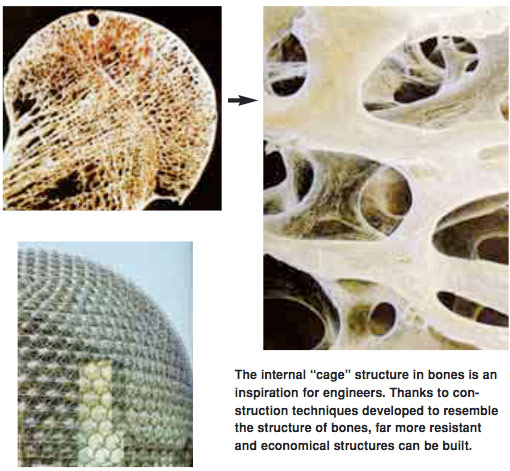
Indeed, in the second half of the twentieth century, engineers developed a technique adapted from the structure of bone in the construction of difficult, lengthy and costly projects such as skyscrapers and bridges. Under this method, known as the cage system, a structure’s load-bearing elements are constructed not as a single slab, but in the form of interconnected ribs. With the benefit of complex calculations capable of being performed by computer—and replicating the characteristics in bones— large bridges and industrial structures were built far stronger and far more economically.
However, the system inside the bones is far more complex than the technique employed in these buildings. Bones possess two seemingly contradictory features at once: strength and lightness. Due to the materials employed in their construction, however, buildings do not possess these two characteristics together. The porous, hollowed structure of bones makes them light, though they are also exceedingly strong and resistant.
The simultaneous presence of these two features, lightness and strength, imparts a number of benefits on human beings. Any contrary state of affairs would have lethal consequences. If bones possessed only one of these two characteristics—if they were strong but heavy, for example—then the entire skeleton would be far too weighty for human muscles to carry. People’s freedom of movement would decrease, severely restricting their daily lives. And as a result of this hardness and brittleness in the bones, the slightest blow would lead to cracks and fractures.
In the exact opposite case—if the bones were light, but not hard—the body could not exist in its present form. Many vitally important organs such as the brain and heart would be exposed to constant danger.
Furthermore, bones possess different features depending on the position they occupy in the body. All bones are strong and elastic, although the levels of these properties do vary. The rib cage, for example, is strong enough to protect such vital organs as the heart and lungs, but also possesses the capacity to expand and contract in such a way as to permit easy breathing. If the ribcage consisted of bones as hard as the skull, then breathing would be almost impossible, and the lungs would become trapped in this hard cage every time you inhaled. As these examples show, detailed examination of just one feature in the bones reveals a great many miracles of creation. However, this is by no means the end of the bones’ special structures.
How Do We Move?
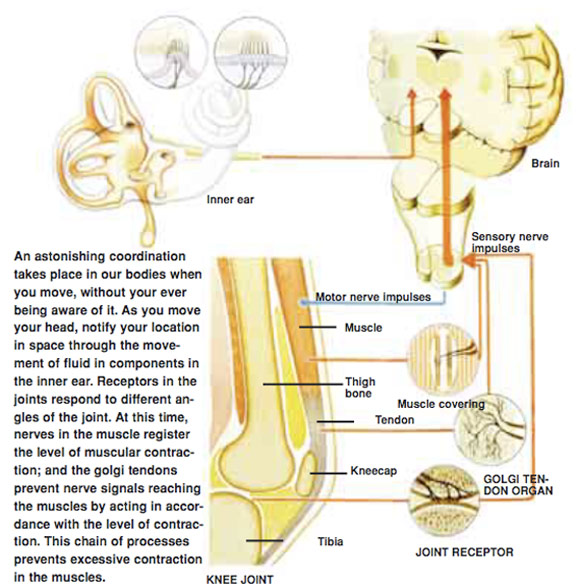
In order to move, we need a muscular system as well as a skeleton. All the bones comprising the skeleton are attached to muscles. As a muscle contracts, it pulls on a bone and enables it to move. In this way, the muscles and bones act together, allowing you to walk, sit, stand up and perform many other movements. In the actions we perform countless times throughout the course of the day, your bones and muscles are used together. You walk, speak, eat, sit and lie down only thanks to the coordinated functions of your muscular-skeletal system.
The muscular system understands the bones’ structure and functions, and the bones are equally well acquainted with the muscles; they literally understand each other. When you go to sit down, the knee joint bends, together with the leg muscles contracting. You are thus able to sit down without difficulty, and stand up again. The muscle surrounds and attaches to the bone so perfectly that every condition necessary for the muscle’s contraction is met. The tendons never come loose from the bone, and neither does the bone tear the muscle, except in cases of injury. These two entirely different complex tissues with their entirely separate systems cooperate with each other perfectly.
So how did this cooperation come into being? How did these flawless systems, a few examples of which we shall be considering in some detail, arise in the human body
Thanks to our mobile joints, we experience no difficulty and feel no pain in moving, because our joints possess a special creation. There is a space between the joints, filled with fluid that serves to lubricate the joints and prevents the bones from wearing down. Allah has no partners in creation.
First, in order for vital functions to be performed, clearly they must all be present as a whole, to have emerged at a single moment. It is therefore impossible for complex bodily systems to have developed gradually, on their own. In addition, tissues such as muscle or bone clearly cannot possess such attributes as awareness, knowledge, calculation or cooperation. This leads us to only one conclusion: that mankind was created by a creator. That Creator is Allah, He Who is aware of all, Who knows the needs of every living thing down to the very finest detail. Allah creates human beings’ bones and Who permits them to work in unison by attaching them to muscles. Allah knows all forms of creation. There is no doubt that Allah creates everything to perfection.
How many Signs there are in the heavens and earth! Yet they pass them by, turning away from them. Most of them do not believe in Allah without associating others with Him. Do they feel secure that the all-enveloping punishment of Allah will not come upon them, or that the Last Hour will not come upon them all of a sudden when they least expect it? (Surah Yusuf: 105-107)
The Perfect Lubrication System Between the Bones
Bones possess different features, depending on where they are located in the body. For example, those skeletal bones that move constantly need very different support to those that remain largely immobile. We can consider your joints as examples. Since the vertebrae that comprise your spinal column, and the joints in your legs, arms, hands and feet are in constant motion, they also need support systems.
 |
Our bodies have many kinds of joints, with just
the right features for the movements we perform. |
Friction can occur anywhere that the moving parts of any mechanical device make contact with each other. Where there is friction, parts break down eventually. Every moving mechanical system, from a simple door hinge to a car engine with the latest technology, needs to be regularly lubricated. However, lubrication does not entirely eradicate wear, but only delays it. For example, even though car engines are lubricated every five thousand kilometres wear can still not be entirely eliminated. That is why engine parts constantly need changing.
But even though the joints of humans and animals are in constant motion throughout their lives, they never require maintenance in any form. If you think of a human covering a distance of around 100,000 kilometers (62,140 miles) in a lifetime, the miraculous aspect of this becomes all the more apparent.
Were it not for the assistance from your joints, you would be unable to move, because all your bodily movements occur thanks to how your joints move against one another. During a basketball match, what are the responsibilities of the players’ joints as they run, dribbling the ball?
Anywhere two bones come together, the duty of the joint is to keep the distance between the bones as great as possible to prevent any friction. But in such a condition, it would be impossible for the knees, elbows or wrists to move comfortably. Were it not for the joints’ unique structure and the buffer zone in between them, you would be able to move only in stops and starts, like a robot.
Scientists have been studying the joints’ attributes for many years now, particularly how they prevent friction. Their aim is to adapt to robots this perfect system in the human body. At first, researchers thought that the absence of friction in the wrists stemmed from fluid in the joints, but subsequently they realized that this fluid had no power to prevent friction. In a most superior example of creation, the surfaces of the joints were covered with a fine layer of porous cartilage, underneath which was a dense liquid. In the event of pressure on one part of the joint, the bone pushes this liquid out through the cartilage, and the joint surfaces are allowed to slide just as if they were coated in oil.
As we have seen, human beings possess a flawless creation in all aspects, and this allows them to move.
The Skeletal System’s Superior Load-Bearing Capacity
In addition to their perfect functions, the bones comprising the skeleton also have a flawless internal structure, with the capacity and strength to bear weight with no difficulty. Indeed, a rather wide safety margin has been included, for any difficulties the body might conceivably be exposed to.
The pelvic bone has one of the greatest load-bearing capacities, able to withstand a load of one ton in the upright position. Indeed, with every step you take, you place on this bone a load of three times the weight of your body. When a pole-vaulter lands, the pelvic bone is exposed to a pressure of 1,400 kilos (3,086 pounds) per square foot. The bones in your body are subjected to intense weight and pressure every time you lie down, sit, or stand up from a sitting position. During all these movements that you perform without thinking, a complex skeletal system goes into action in a most systematic manner.
 |
Why do you feel no pain when moving your arms or legs?
Under normal conditions, one would expect constant friction
to lead to wear and erosion in the bones.
But no such thing actually happens, thanks to the special
joint fluid that prevents friction. This fluid prevents wear
and damage to the joint surface by making it slippery. You are
thus able to move comfortably thanks to this flawless creation in our bodies.
|
In order to fully grasp the perfection of the creation in the bones let us draw a comparison. Steel is one of the strongest and most functional materials, being both strong and flexible. Yet a piece of bone is actually much stronger than solid steel, and ten times more flexible. Bones are also superior in terms of weight. A steel carcass is three times heavier, in relative terms, than the human skeleton.
It is not only steel, but any other material used by mankind that lags far behind when compared with the structure of bones. It will be seen that compared with the same weight of reinforced concrete, bones have four times the load bearing capacity.
Bones: The Body’s Living Bank
 |
Bones are the body’s
storehouses of calcium.
The source of that calcium is
milk and similar foods. |
Most people imagine bones to be inanimate substances, but apart from their outer layers, they are in fact living tissues, containing microscopic blood vessels, nerves, and bone marrow. At the same time, the bones store vital substances such as calcium and phosphorus and return these to the body when needed for any reason.
What would happen if there were no calcium in the body?
Calcium assumes a most important role in ensuring that stimuli from the outside environment reach the nerves. Without calcium, signals could not reach the nerves, leading to paralysis and failure of the internal organs, eventually resulting in death.
But calcium’s importance goes even further.
When you cut yourself, the blood congeals soon afterwards, preventing your death from blood loss. This is of vital importance. If blood did not clot, all of it would eventually flow out of your body from even the tiniest cut as in the case of fluid running out of a barrel with a hole in the bottom. However, a miraculous mechanism ensures that clotting does take place to protect us from certain death, as you saw in Chapter 1. Calcium is one of the main factors that sets this mechanism in motion, and were it not for the calcium stored in the bones, your blood would not clot.
 |
he pelvic bone, tibia, fibula and finger bones are among
the kind of long bones illustrated below. |
Your Bone Cells’ Ability to Trap Calcium
We have already stated that the bone cells serve as calcium and phosphorus depots. There is another important point here that needs to be dwelt on. A bone cell, which has no sense organs, can easily distinguish calcium and phosphorus from the thousands of different substances in the blood, and then traps these atoms with perfect accuracy.
 |
It is vitally important that the calcium level in the body should
remain at specific levels. When the level of calcium in the blood falls,
parathormone immediately goes into action to bring about a transition of
calcium from bone to the bloodstream. In addition, calcium is prevented
from being expelled by the kidneys and calcium absorbance is increased.
When the level of calcium in the blood rises, calcitonin is secreted,
and calcium passes from the blood to the bones.
|
Unless he has received special training, no human being can possibly distinguish between different elements such as calcium, phosphorus, iron, zinc placed before him in powder form. Could you separate and remove all the calcium particles from this mixture? If not, then you can better understand the success achieved by the bone cell, which has not received any special training in this field.
At the same time, the bone cell is also most obedient, just like all the other cells in the body. When instructed to store calcium or to stop, it obeys at once.
69 The bone cells continue to serve, day and night, with great ability and discipline.
Bone Marrow: The Machine That Produces Blood Cells
A large hollow area in the centers of bones contains the marrow that ensures the production of the necessary materials for blood. Marrow consists of fat, water, erythrocytes and leucocytes. Yellow marrow, consisting almost entirely of fat, is found in some bones. In red marrow are produced and stored the red blood cells that provide carry O2 and CO2 and the white cells that protect against infections.
The hemoglobin molecules in the erythrocytes produced in red marrow distribute oxygen to all the cells after taking it on in the lungs. If the level of blood production in red marrow were just a little lower, then we would develop anemia and eventually die from lack of oxygen. Production in the marrow therefore needs to be constant. Various precautions have been taken inside the body to ensure that nothing ever goes wrong with such a vital function.
These precautions may be compared to strategies being changed according to the course of an enemy’s progress.
When the body is fighting an infection, defensive white cells are produced in the red marrow. Yet these cells may not always be enough. In the event that the enemy puts up a better attack than expected, the body sounds the alarm. In addition to mounting a serious defence, the body also has to go onto the attack. At this stage the yellow marrow enters the equation. However, since yellow marrow consists solely of fats, what role can fats play in the defense?
Of course, the fats themselves play no role in the defense. The yellow marrow’s basic role is to store fat in the body and to begin producing blood cells when it receives an urgent signal that the red marrow cannot cope on its own. The objective is to win by establishing one single force to cooperate against the foe.
This important detail can never be explained by the Darwinian logic that links all of life to blind coincidences, because fluids inside the bones, devoid of reason or logic, decide to cooperate together in their struggle against an enemy. At the same time, those fluids demonstrate characteristics they have never employed before so as to perform different functions.
All these facts point very clearly towards creation. Examples like these of Allah’s superior creation are all opportunities for one to turn to Allah and comprehend His might and greatness.
Every human being, created with so many superior features, both known and unknown, has the duty to give thanks to Allah, Who endows us with bodies so perfect in every way.
A Self-Repairing Block of Stone
Bones are as hard as stone, yet they nonetheless still break from time to time. However, the broken region heals itself shortly afterwards.
If bones were a little less resilient than they are—if they stored a little less calcium—they would break under the slightest pressure. If bones also lacked this self-repairing ability, no doubt that this would mean a great deal of suffering and trouble. People would be left crippled because their bones did not mend, and death could even result from breaks in the ribs of skull.
However, human beings have been endowed with a blessing, of which they are generally unaware. Apart from following very serious accidents, bones tend not to break. And those that do for any reason soon fuse back together.
After being broken, a bone immediately starts to repair itself, and once the repair process is complete, it becomes even stronger than before, to replicate this most extraordinary phenomenon, scientific research is aimed at producing a substance similar to that which comprises human bones. Yet to date, no engineer has been able to produce a substance as strong yet as light and functional as bone, that constantly grows and lubricates itself in the way bone does, requires no shutdown time, and repairs itself when damaged.
70
The Vital Function of Bone Cells
Various kinds of bone cells, all of which perform very different functions inside a single bone, all work together. Osteoblast cells, the makers of bone, ensure the constant renewal of bone by hardening protein with minerals. Another bone cell known as the osteoclast permits the exchange of nutrients between blood and bone tissues, as well as playing a role in the expulsion of wastes from inside the bone.
Another function of the osteoblasts is to enable bone to change dimensions and reach adult form and proportions, by leading to collapse of the tissue in the interior surfaces, bone marrow hollows and porous bone tissues. It also has an effect on the external bone surfaces by shrinking protrusions there. Uniform thickness is thus maintained throughout.
71
As the osteoclast cells perform their work in the bone, osteoblast cells do not stand idly by but begin making new bone that will constitute the skeleton. Osteoblasts bear a heavier burden during childhood, since as growth is more rapid during that stage, and there needs to be more bone-making than tearing down. But once the skeleton has reached a certain level of maturity, the processes of bone making and destruction begin to balance one another. The bone’s shape and dimensions remain the same during this process, and the calcium level in the blood and the fluid between the tissues is also regulated.
The cells present in the bones of every human being, perform exactly the same functions in everyone. They all know how to reduce the size of the bone surface, know the differences between the skull and the pelvic bone, and the different forms they will give to them, when growth has to stop, and what their thickness must be. They also act in the knowledge that during childhood, they have more work to do; and possess knowledge of what calcium levels should be at which time.
As you see, the bone cells knew one another’s abilities very well and act in a planned manner. They accurately determine when they need to engage in various processes. This may be compared to the production schedule in a factory, which must prevent excess production and the accumulation of too much overstock in the warehouse, as well as under-production that will result in shortages. Factories have special planners involved in such work who produce regular daily or weekly inventories to ensure balanced production in the factory.
 |
Long bones are made up units known as osteons.
Three of them are shown in (A).
The bone cells are in the gaps (lacunae) in the bone structure.
Their shapes are ideally suited to these spaces.
Thanks to their cytoplasmic extensions, the bone spaces establish
connections with neighboring cells by combining together.
A single bone cell (osteocyte) is shown in (B).
This creation in the bones with all its details, is flawless in all regards.
|
In a comparable way, bone cells maintain the level of calcium at a fixed rate. Osteoblast and osteoclast cells work in a balanced manner, in that the osteoblast engages in production, while the osteoclast prevents any excess. Their communication is impeccable, and the balance never goes wrong, thanks to which your bones always maintain a sufficient level of calcium.
To claim that bone cells acquired their capabilities of production-planning and balance-maintenance of their own will, or that these came into being by sheer chance, conflicts with logic and with science in every possible way.
A cell cannot plan or make decisions, or become aware of the imbalances in the body. It cannot learn. Yet each and every one of the trillions of cells in the human body behaves like a conscious being, and even exhibits a higher intellect than that of human beings. This shows that cells are directed by a superior Force: It is Almighty Allah Who inspires in them knowledge of how they are to behave.
Have they not reflected within themselves? Allah did not create the heavens and the Earth and everything between them except with truth and for a fixed term. Yet many people reject the meeting with their Lord. (Surat ar-Rum: 8)
The Spine: The Body’s Mobile Joist
The spine consists of a number of components. Through 33 small, round bones placed one on top of the other runs the spinal cord, which provides the coordination between the brain and all the organs, which are equipped with a major communications network. These bones have been combined with a structure that is attached to the ribs and the internal organs and results in the body’s upright posture. The large structure formed by these 33 bones is one of the greatest engineering marvels in the world.
The most important task of the backbone is load-bearing. The upper body’s weight is borne by the backbone. The vertebrae composing the spine move on top of one another with every step you take, which movement naturally gives rise to friction. Friction in turn will lead to erosion, and that—for a vertebra protecting a vital communication network and at the same time bearing a heavy load—can cause severe problems. So how is this structure of 33 discs protected from compression—and friction?
Within the backbone has been located the best possible protective system. Between each of the vertebrae comprising the spinal cord has been placed a cartilage disc that works like a shock absorber to soak up pressure.
The backbone’s shape, in the form of a letter S, has also been created in such a way as to assist in load- bearing by allowing weight to be distributed evenly. Due to your body’s weight, an impact from the ground is produced every time you take a step. This force does your body no damage, however, thanks to the shock absorbers in the spine and its force-dispersing shape. Were it not for the elasticity and special structure that reduce the counterforce, then the force created would be transmitted directly to the head, and the upper part of the spinal column would shatter the bones of the skull and enter the brain.
That does not happen, however. You continue to lead a healthy life with the perfect engineering created by Allah in your human body.
Mechanical Creation in the Skeleton
Another example of the flawless creation in the bones is the bones of the feet. Each human foot is made up of 26 bones, meaning that a quarter of all the bones in the human body are in the feet. The foot possesses a very special structure created to facilitate its mechanical functions. We may compare the perfection in the structure of the sole of the foot to the engineering of a bridge—the sole’s curved shape helps supports the weight of the body.
We use automobiles as another example. When a car’s gas pedal is depressed the pedal works like a lever. In the same way, when you perform a lifting movement, your toes work like a hydraulic jack, lifting your body into the air. And when you run, they work as shock absorbers for the legs, so that no harm befalls the feet, veins or muscles during all these movements.
To fully grasp the importance of this special situation, compare any other organ—your hand, for example—with your feet in terms of weight-bearing capacity. Let’s assume that the same weight is applied to your hands every time you stand up, that you place your hands on a table and then place on top of them a weight of 70 to 80 kilograms (155 to 175 pounds). The flesh will soon be crushed, your veins will burst, and even your bones will even be shattered. Yet in your feet, which bear the weight of your
body all day long, the veins do not burst, nor are the tissues crushed, because the foot is specially created to carry weight.
This is another proof of Allah’s affection for human beings. Allah reveals Himself to us by creating human bodies whose creation allows us them to live in a most comfortable manner, feeling no discomfort, and easily able to meet all our needs. The signs of Allah are visible everywhere for those who can see. The important thing is to turn to Allah, the Lord of all, by thinking deeply about this evidence.
In the creation of the heavens and Earth, and the alternation of the night and day, and the ships which sail the seas to people’s benefit, and the water which Allah sends down from the sky—by which He brings the earth to life when it was dead and scatters about in it creatures of every kind—and the varying direction of the winds, and the clouds subservient between heaven and earth, there are Signs for people who use their intellect. (Surat al-Baqara: 164)
The Cage That Protects the Brain: The Skull
The skull, a fusion of eight separate bones, surrounds the brain, affording it the most excellent protection. Just as bones in the body have different properties according to their location, so the skull has its own unique creation. Unlike other bones, the sutures where the skull’s bones join together bear protrusions and indentations, because the skull bones’ fusion points are created to be able to lie alongside one another.
In adults, the skull is very hard and strong, but completely different in newborn babies. The skull of a baby that has only recently left its mother’s womb has a soft structure, and the eight bones comprising the skull have not yet joined together. This might seem a disadvantage as far as health is concerned, but is actually a most important feature that preserves the baby’s life during birth
.72 If its skull had a hard bony structure, with no gaps between the component bones, there would be a high risk of the baby’s head being crushed during birth. But because of the cartilaginous nature of a baby’s skull, the bones are flexible enough to bend.
EVOLUTION’S BIPEDALISM QUANDARY
As already made clear, thanks to a perfect bone structure and a flawless skeleton, we are able to perform almost any action we choose without difficulty. How do evolutionists try to account for this?
Evolutionists maintain that our bipedalism evolved from apes’ four-footed gait. This claim is quite impossible for a great many reasons.
First, a huge gulf separating human anatomy from primates’ is that humans walk upright on two legs—a unique method of walking. Other living things have a skeletal structure that leans forward, and they walk on four legs, rising onto two legs only in cases of need, leaving them with a limited capability of movement.
It will be useful to point out that these claims by evolutionists are actually inconsistent, because according to their general logic, there is a general progression towards improvement over time. In other words, it’s no advantage for a living thing to abandon some good feature and thereby regress. For monkeys, walking on four legs permits easier, faster and more productive movement. To compare the capabilities of humans and animals, it is impossible for a man to swing from tree to tree, or to run like the cheetah at 125 kilometers (77.6 miles) per hour. From that point of view, evolution is self-contradictory. According to its logic, monkeys have nothing to gain from walking on two legs.
Another point that invalidates the concept of evolution toward bipedalism is that it’s incompatible with the gradual development model proposed by Darwin. According to this claim, a creature that walked on four legs, later began walking on both four legs and two, and gradually came to walk on two legs alone. However, it is impossible for such a progression to have happened. The paleontologist Robin Crompton performed a study on that very subject and concluded that a living thing will either be able to walk completely on four legs, or else completely upright (Ruth Henke, “Aufrecht aus den Baumen,” Focus, Vol. 39, 1996, p. 178). An intermediate gait between walking on two legs and four will consume excessive energy.
Research has proved that the ape’s forward-leaning skeleton could not have evolved into a human’s suited to walking on two. Indeed, some evolutionists are aware of this, and refer to human beings’ emergence as a mystery. The evolutionary paleoanthropologist Elaine Morgan, for instance, cites four major mysteries that cannot be unraveled in terms of evolution:
Four of the most outstanding mysteries about humans are: 1) Why do they walk on two legs? 2) Why have they lost their fur? 3) Why have they developed such large brains? 4) Why did they learn to speak? The orthodox answers to these questions are: 1) “We do not yet know”; 2) “We do not yet know”; 3) “We do not yet know’” 4) “We do not yet know’” The list of questions could be considerably lengthened without affecting the monotony of the answers. (Elaine Morgan, The Scars of Evolution, New York: Oxford University Press, 1994, p. 5.)
Flexibility by itself is not enough, of course. The skull also needs room to expand — provided by the gaps in the skull that are not yet closed until after birth. The bones of the skull squeeze together to close this gap, and even slide over one another, decreasing the skull’s volume. In this way, the baby is born safely after passing through a birth canal only half the diameter of the baby’s head.
What if none of these were to apply? For instance, if the skull bones were still flexible but there were no gap between them, or the exact opposite—if there were a gap, but the bones were not flexible—then in either case, the baby’s brain would suffer enormous damage. It is essential that both these properties be present at the moment of birth. Yet there is one very important factor here: the mother’s pelvic bones.
Toward the final months of pregnancy, a woman’s pelvic bones expand and separate slightly from one another. This means that the baby can be born without its head being crushed.
Every feature in the human body has been created in order to protect health and to prevent any damage. The question here is, “How did the clearly visible planning, and the creation manifested within it, come into being?” The only answer is that this incomparable creation belongs to Allah, Who created and laid out in order everything in the universe. Allah possesses a most superior intelligence. Everyone who can understand His infinite intelligence and draws conclusions from that will achieve true salvation. A person’s duty is to consider these blessings that Allah has created inside him and to give thanks for them. Allah loves the grateful.
. . . Allah shows favor to humanity, but most of them are not thankful. (Surah Yunus: 60)
69- Montgomery, Biochemistry, s.567-568
70- Brand & Yancey, 1980, s.91
71- Prof. Dr. Ahmet Noyan, Ya?amda ve Hekimlikte Fizyoloji, s.1046-1047
72- Marshall Cavendish, The Illustrated Encyclopedia of The Human Body, s. 40